
| Buyer demand weakened in September, although enquiry levels remain considerably stronger than they were six months ago | Prime housing markets remain relatively resilient, with cash buyers accounting for more than half of transactions this year | A new government-backed scheme aims to help first-time buyers purchase new-build homes with a 2.5% deposit |
Housing market softens
The residential property market experienced a setback in September, according to the latest survey from the Royal Institution of Chartered Surveyors (RICS).
New buyer enquiries fell to a net balance of -22% last month, down from -18% in August, marking the first decline since March 2026. However, this latest reading is a significant improvement on -41% recorded six months earlier. Agreed sales fell slightly to a net balance of -18% but remain above the three-month average of -25%. Expectations for sales over the next three months softened from -6% to -3%. The survey suggested that supply may be increasing, with new sales instructions posting a net balance of +6% – the first positive reading since mid-2025.
Head of Market Research and Analysis at RICS, Tarrant Parsons, commented: “A renewed rise in interest rate expectations has created a fresh headwind for the housing market, with buyers becoming a little more cautious and sales activity losing some momentum this month.”
Prime markets show stability
Despite ongoing political uncertainty, prime property markets have remained relatively stable, according to Savills.
Prime house prices have fallen, but in Q3 they declined at a slower pace than in Q2. In the face of fluctuating borrowing costs, cash buyers have accounted for more than half of prime purchases so far this year. Price sensitivity remains, with sellers often competing for interest due to a build-up of unsold prime properties. Buyers have been particularly selective in prime central London, where secondary and overpriced stock has proved much harder to sell. Meanwhile, prime markets have been most resilient in the Midlands, North of England, Scotland and Wales.
Frances McDonald, Director of Residential Research at Savills, said, “The experience of the past year tells us that activity doesn’t necessarily depend on perfect market conditions. Buyers and sellers have continued to transact, adapting their expectations to an evolving economic and political environment.”
Government announces new FTB scheme
The government has confirmed a new first-time buyer (FTB) scheme, details of which will be announced at the Budget.
Your First Home is expected to help FTBs purchase a new-build home with a 2.5% deposit, supported by a 20% government-backed equity loan. This Help-to-Buy style loan will have an initial interest-free period, the length of which has yet to be announced. Under this proposed scheme, buyers would need a mortgage that is 77.5% of the property’s value. The government has said the scheme could save buyers hundreds of pounds a month compared with a 95% loan-to-value (LTV) mortgage.
Your First Home will only be available on new-build properties from a participating developer. Full details will be announced at the Budget on Wednesday 28 October. The scheme is not to be confused with the First Homes Scheme, which offers FTBs discounts of at least 30% and up to 50% on selected homes.
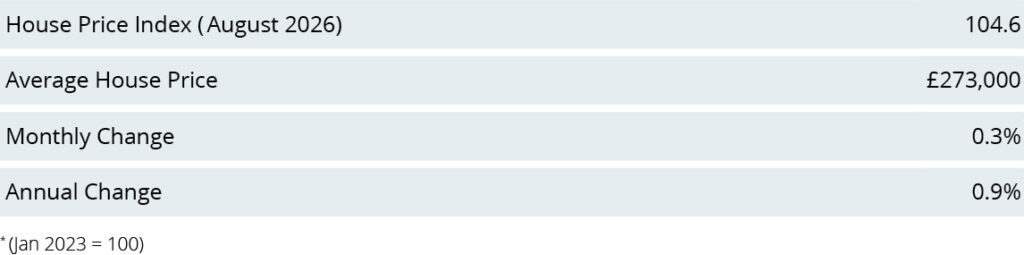
House prices headline statistics
- Average house prices in the UK increased by 0.9% in the year to August 2026
- House prices increased by 0.3% on average between July and August 2026
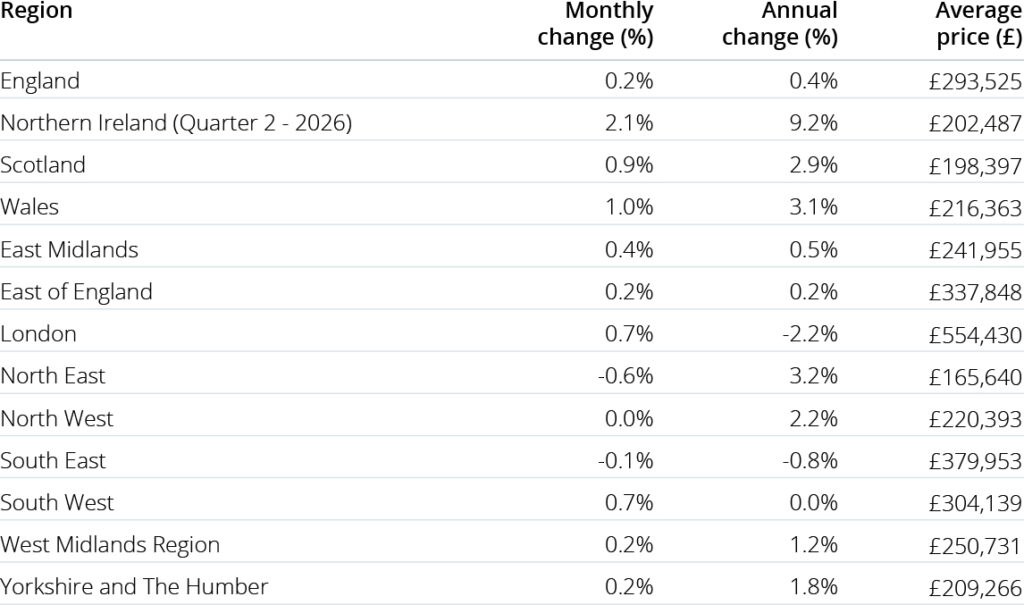
- The average house price in London was £554,430.
House prices – Price change by region
Average monthly price by property type – August 2026

A rise in rental yields
In Q3, the average annual rental yield for England and Wales increased annually by 0.4%, reaching 7.9%.
According to the Q3 research, Yorkshire and the Humber was the region with the highest rental yield – it recorded an average of 9.3%, which is up significantly from 8.2% the previous year. The North East followed closely behind with an average annual yield of 9.2%. At the other end of the list, Greater London was the area with the lowest yield at 6.4%; despite this, it is the region with the highest monthly rent, averaging at £2,597 in Q3. Only East Anglia, the North West and Wales experienced an annual decline in average rental yields. The report also suggests that landlords are investing in more property, with the average portfolio rising to 18 properties in Q3, up from 12 in the same period last year.
(All details are correct at the time of writing 21/10/26)